Why Is Voltage Protection Device (VPD) Essential for Home and Industrial Electrical Safety?
Abstract
Voltage fluctuations, overvoltage, undervoltage, and surge currents are common hidden dangers in power supply systems, which can easily cause equipment burnout, shortened service life, and even fire risks. VPD (Voltage Protection Device) provides real-time monitoring, quick cut-off, and automatic recovery functions to protect circuits and electrical equipment. This article explains the working principle, classification, application scenarios, selection criteria, and installation specifications of Voltage Protection Device, combined with practical cases to help users understand the importance of voltage protection and choose suitable products. It also introduces professional manufacturers and high-quality solutions to improve the safety and stability of power consumption.
Table of Contents
- 1. Common Voltage Risks in Modern Power Systems
- 2. Core Functions and Working Principles of Voltage Protection Device
- 3. Main Types and Technical Parameters of Voltage Protection Device
- 4. Application Scenarios of Voltage Protection Device
- 5. Selection Criteria for Voltage Protection Device
- 6. Installation and Use Specifications
- 7. FAQ
- 8. Conclusion and Recommended Solutions
1. Common Voltage Risks in Modern Power Systems
In daily life and industrial production, the stability of power supply voltage is crucial to the safe operation of electrical equipment. However, in actual operation, the power grid is often affected by various factors, resulting in voltage abnormalities. These abnormalities are usually invisible and intangible, but they will cause continuous damage to electrical equipment over time, and even lead to serious safety accidents.
Overvoltage refers to the voltage exceeding the normal working range, such as the voltage suddenly rising from 220V to 270V or higher. This situation is mostly caused by lightning strikes, grid switching operations, short-circuit faults, etc. Overvoltage will directly break through the insulation layer of electrical equipment, burn out circuit boards, coils and other components, and cause permanent damage to the equipment. For household appliances, overvoltage is the main culprit for burning out televisions, refrigerators, air conditioners and other equipment; for industrial equipment, overvoltage will lead to downtime of production lines, damage to precision instruments, and huge economic losses.
Undervoltage means that the voltage is lower than the normal working value, such as dropping from 220V to 170V or even lower. Undervoltage will cause the equipment to fail to start normally, the motor to stall, the current to increase sharply, and the equipment to heat up seriously. Long-term undervoltage operation will accelerate the aging of the equipment, shorten the service life, and may also cause circuit tripping and power failure, affecting normal production and life.
In addition to overvoltage and undervoltage, surge currents and voltage instantaneous fluctuations are also common risks. Surge currents are instantaneous high-intensity currents, which are often accompanied by voltage abnormalities, which can impact the circuit and damage sensitive electronic components. Voltage instantaneous fluctuations will cause unstable operation of equipment, screen flickering, data errors and other problems, especially for precision electronic equipment, medical equipment and communication equipment, which have a great impact.
According to relevant electrical safety statistics, more than 60% of electrical equipment failures are caused by voltage abnormalities. These failures not only increase the cost of equipment maintenance and replacement, but also bring potential safety hazards such as electric shocks and fires. Therefore, it is urgent to take effective voltage protection measures to control voltage within a safe range and ensure the safe operation of equipment.
2. Core Functions and Working Principles of Voltage Protection Device
Voltage Protection Device is a special electrical equipment designed to monitor and protect circuit voltage. Its core goal is to detect voltage abnormalities in real time, quickly cut off the circuit when the voltage exceeds the safe range, and automatically restore the power supply after the voltage returns to normal, so as to realize all-round protection of the circuit and equipment.
The working principle of Voltage Protection Device is based on real-time voltage sampling and intelligent judgment. The device is equipped with a high-precision voltage sampling circuit, which can continuously collect the voltage value of the power supply line. The collected voltage signal is transmitted to the central control unit, which compares the actual voltage with the set safe voltage range (overvoltage threshold and undervoltage threshold).
When the actual voltage is higher than the overvoltage threshold or lower than the undervoltage threshold, the control unit immediately sends a control signal to trigger the relay or circuit breaker to quickly cut off the power supply, with a cut-off time usually not exceeding 1 second. This rapid response speed can effectively prevent voltage abnormalities from causing damage to the rear-end equipment. After the power supply voltage returns to the normal safe range, the device will automatically close the circuit after a set delay time to restore the power supply, without manual operation, which is convenient and efficient.
High-quality Voltage Protection Device also has overcurrent protection function, which can monitor the current in the circuit at the same time. When the current exceeds the rated value due to short circuit, overload and other reasons, the device will also cut off the circuit in time to realize the dual protection of voltage and current. In addition, some advanced models adopt modular design, with stable performance, long service life, and can adapt to different working environments.
VPD subverts the traditional passive protection mode, realizes active real-time monitoring and automatic protection, and is an important guarantee for modern electrical safety. It is like a dedicated "security guard" for the circuit, guarding the safety of voltage 24 hours a day, eliminating hidden dangers in the bud.
3. Main Types and Technical Parameters of Voltage Protection Device
There are various types of Voltage Protection Device on the market, which can be divided into different categories according to the application scenario, current specification, number of phases and adjustment function. Understanding the types and parameters helps users choose the right product.
3.1 Classification by Current Specification
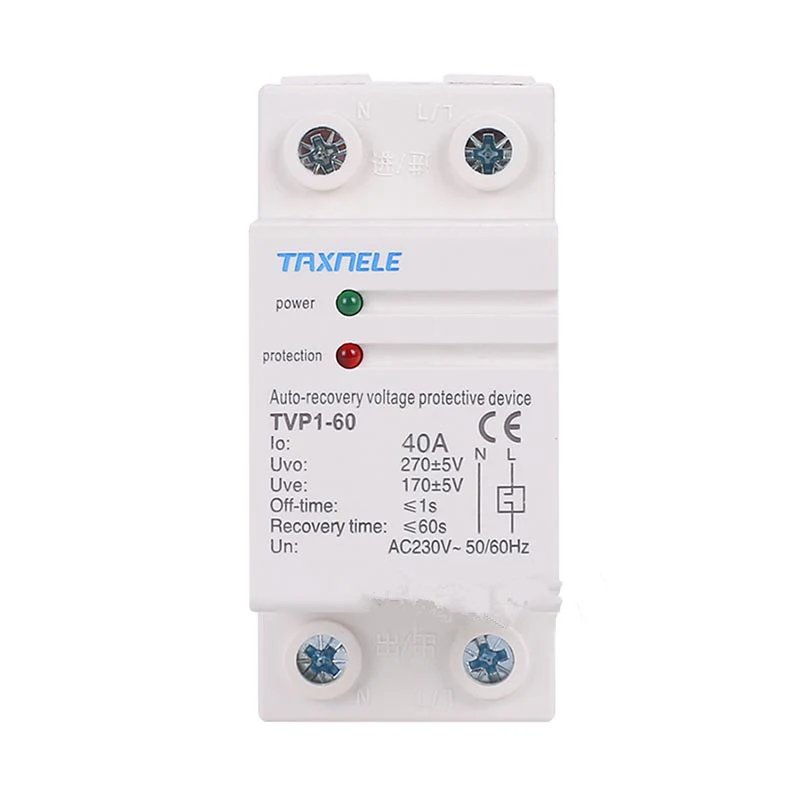
- 40A Voltage Protection Device: suitable for household small-power circuits, such as lighting, small appliances, etc.
- 63A Voltage Protection Device: common in household main circuits, small shops and office places, with strong applicability.
- 100A Voltage Protection Device: used in industrial and commercial scenarios with large power consumption, such as small factories, shops, etc.
3.2 Classification by Phase Number
- Single-phase Voltage Protection Device: for 220V single-phase power supply, widely used in households, offices, etc.
- Three-phase Voltage Protection Device: for 380V three-phase power supply, suitable for industrial production lines, large equipment, etc.
3.3 Classification by Adjustment Function
- Fixed value type: the overvoltage and undervoltage thresholds are fixed, simple structure, cost-effective.
- Adjustable type: the protection voltage and recovery delay time can be adjusted manually, suitable for special scenarios with high requirements.
3.4 Core Technical Parameters
| Parameter | Description |
|---|---|
| Rated Voltage | AC230V~50/60Hz (single-phase), matching common power supply standards |
| Overvoltage Threshold | 270±5V (fixed type), 230V-300V (adjustable type) |
| Undervoltage Threshold | 170±5V (fixed type), 145-210V (adjustable type) |
| Cut-off Time | ≤1s, fast response to avoid equipment damage |
| Recovery Time | ≤60s (fixed type), 3s-300s (adjustable type) |
| Overcurrent Protection | 1A-63A (adjustable), dual protection of voltage and current |
These parameters are the core basis for measuring the performance of Voltage Protection Device. High-quality products adopt high-quality electronic components and stable circuit design to ensure the accuracy and reliability of parameter indicators.
4. Application Scenarios of Voltage Protection Device
Voltage Protection Device has a wide range of applications, covering household, commercial, industrial and other fields, providing voltage protection for different types of electrical equipment.
In the household sector, Voltage Protection Device is mainly used in the home main gate, kitchen, bathroom and other key circuits. It can protect refrigerators, air conditioners, washing machines, televisions and other household appliances from overvoltage and undervoltage damage. Especially in areas with unstable power supply or frequent thunderstorms, installing VPD can greatly reduce the probability of electrical equipment burnout and ensure the safety of family electricity use.
In the commercial field, office buildings, shops, hotels and other places need stable power supply to support the operation of computers, printers, cash registers, lighting systems and other equipment. Voltage Protection Device can prevent voltage abnormalities from causing equipment downtime and data loss, ensuring the normal operation of commercial activities. For small shops with high power consumption such as catering and supermarkets, high-current models can meet the load demand.
In the industrial field, three-phase Voltage Protection Device is widely used in production lines, motors, pumps, fans and other equipment. Industrial equipment has high power and high precision requirements, and voltage abnormalities will cause huge losses. The device's automatic recovery and overcurrent protection functions can reduce downtime and improve production efficiency. It is an indispensable safety device in industrial power distribution systems.
In addition, communication base stations, medical equipment, monitoring systems and other special scenarios also need Voltage Protection Device for protection. These scenarios have high requirements for power stability, and voltage fluctuations will affect the normal operation of equipment and even cause medical accidents or communication interruptions. The high-precision monitoring and fast protection functions of the device can meet the strict safety requirements of these scenarios.
5. Selection Criteria for Voltage Protection Device
Choosing the right Voltage Protection Device is the key to giving full play to its protective effect. Users should select products based on factors such as application scenario, power load, power supply type and functional requirements.
First of all, determine the current specification according to the power load. Calculate the total power of the protected circuit, select the device with rated current greater than the actual working current, and leave a certain margin. For household use, 40A or 63A is usually sufficient; for industrial and commercial use with large power consumption, 100A or higher specifications should be selected.
Secondly, select single-phase or three-phase according to the power supply type. Household and small commercial use 220V single-phase power supply, choose single-phase Voltage Protection Device; industrial production and other 380V three-phase power supply scenarios, choose three-phase products.
Thirdly, choose fixed value or adjustable type according to functional requirements. Ordinary household scenarios can choose fixed value products with simple operation and high cost performance; scenarios with special voltage requirements or need to adjust parameters, such as precision equipment rooms, can choose adjustable models to flexibly set protection thresholds and delay time.
Fourthly, pay attention to product quality and certification. Choose products with CE and other safety certifications, which adopt high-quality electronic components and modular design, with stable performance and long service life. Avoid choosing inferior products to prevent failure to protect or potential safety hazards.
Finally, give priority to products with automatic recovery function. Automatic recovery can avoid the trouble of manual closing after voltage recovery, especially for unattended scenarios, which improves the convenience of use.
6. Installation and Use Specifications
Correct installation and standardized use are important guarantees for the normal operation of Voltage Protection Device. The following steps and precautions should be followed during installation and use.
Before installation, turn off the main power supply to ensure no electricity in the circuit to avoid electric shock accidents. Check the appearance of the device for damage, and confirm that the parameters match the protected circuit.
During installation, connect the input end to the power supply line and the output end to the load equipment according to the wiring diagram. Ensure that the wiring is firm and in good contact, and avoid loose wiring causing heat or poor contact. The device should be installed in a dry, ventilated and non-corrosive gas environment, away from heat sources and water sources.
After installation, turn on the power supply and test the function. Simulate overvoltage and undervoltage conditions to check whether the device can cut off the power supply normally; restore the normal voltage to check whether the automatic recovery function is effective. Confirm that all functions are normal before putting into formal use.
In use, regularly check the working status of the device, such as indicator lights, wiring temperature, etc. If abnormal phenomena such as indicator light off, abnormal heat, frequent tripping are found, immediately cut off the power supply for inspection or contact professional maintenance personnel.
Do not modify the internal circuit of the device without permission to avoid damaging the protection function. For adjustable models, set parameters according to the actual needs of the equipment, and do not set them too loose or too tight to ensure the protection effect.
7. FAQ
Q1: What is the difference between Voltage Protection Device and surge protector?
A: Voltage Protection Device mainly protects against continuous overvoltage, undervoltage and overcurrent, with real-time monitoring and automatic recovery functions; surge protector mainly absorbs instantaneous surge current caused by lightning strikes, etc., focusing on transient impact protection. The two can be used together for all-round protection.
Q2: Can Voltage Protection Device prevent electrical fires?
A: Yes. Voltage abnormalities and overcurrent are important causes of electrical fires. The device can quickly cut off the circuit when abnormalities occur, avoid equipment overheating and short circuit, and effectively reduce the risk of electrical fires.
Q3: How long is the service life of Voltage Protection Device?
A: High-quality products have a service life of 5-10 years under normal use and maintenance. Regular inspection and maintenance can extend the service life. If frequent tripping or functional failure occurs, it should be replaced in time.
Q4: Is it necessary to install Voltage Protection Device in areas with stable power supply?
A: It is still necessary. Even in areas with stable power supply, instantaneous voltage fluctuations may occur due to lightning strikes, grid faults and other accidental factors, which will damage equipment. Installation of the device can prevent accidental risks.
Q5: Can adjustable Voltage Protection Device be operated by non-professionals?
A: It is recommended to set parameters by professional electricians according to equipment requirements to avoid incorrect setting affecting the protection effect. Non-professionals should not adjust parameters at will.
8. Conclusion and Recommended Solutions
Voltage abnormality is a potential hidden danger in power supply systems, which threatens the safety of electrical equipment and personal property. Voltage Protection Device, with its real-time monitoring, fast protection and automatic recovery functions, has become an essential safety device in modern power consumption.
Whether it is household, commercial or industrial scenarios, installing high-quality VPD can effectively avoid equipment damage caused by voltage abnormalities, reduce maintenance costs, and improve the safety and stability of power consumption. Choosing products with complete certifications, stable performance and suitable parameters is the key to ensuring the protection effect.
ZHEJIANG SINGI ELECTRICAL LLC is a professional manufacturer of voltage protection equipment, providing a full range of high-quality Voltage Protection Device products, covering 40A, 63A, 100A and other specifications, single-phase and three-phase options, fixed value and adjustable models to meet the needs of different scenarios. The products adopt high-quality electronic components and modular design, with stable performance, complete certifications, and perfect after-sales service.
To ensure your electrical safety and choose reliable voltage protection solutions, contact us now to get professional product selection and technical support!
Previous:No News